
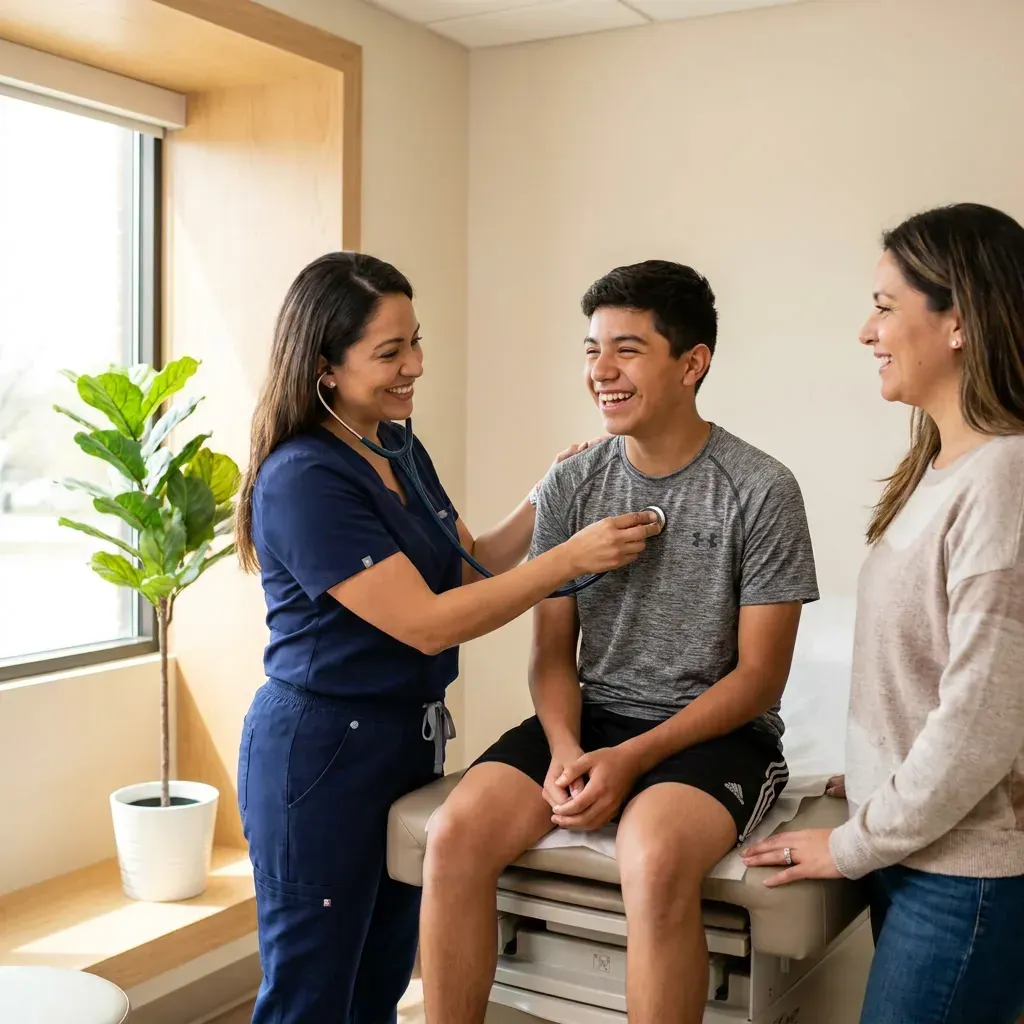
School and Sports Physicals: What Is Checked, What to Bring
November is when middle and high school basketball and wrestling practices get going, park soccer leagues open sign-ups for the winter season and, shortly after, the papers for spring baseball and softball start coming home. Nearly all of them ask for one thing: a signed physical before the first practice. This guide covers what that exam looks at, which questions are worth answering before you leave the house, and how to keep the form from coming back half done.
School or sports: how they differ
Many families assume they are one errand with two names. They overlap, but each puts the weight somewhere else.
| School physical | Sports physical | |
|---|---|---|
| Who asks for it | The school or the district | The coach, the team or the league |
| What it focuses on | General check and the vaccination record | Heart, family history, joints and old injuries |
| What you take home | The school form, filled in | The team form, filled in and signed |
If your child plays on the school team and also in a weekend league, each one usually has its own paper. Bring both: with our school and sports physicals, the form is completed and signed during the visit.
Heart, eyes, spine: what gets looked at in the room
A sports physical is not a rubber stamp. Above all, it looks for anything that could cause trouble once the body is working hard. During the visit the team reviews:
- Family history of heart problems, the single most important question on the whole form
- Blood pressure, pulse and how the heart sounds through the stethoscope
- Vision and hearing
- Spine, joints and earlier injuries that never healed properly
- Weight, height and development
For the school version there is a general check, and the vaccination record is looked over together with the district form.
If something in the history or the exam raises a question about the heart, the medical team explains it calmly before signing off on the sport and tells you what the next step is. Far better to have that talk in November than to get a surprise halfway through the season.
Questions to answer at home first
The slowest part of the visit is not the exam itself: it is remembering family details. Call the grandparents or the aunts and uncles a few days ahead and write the answers down:
- Did any relative die suddenly or for no clear reason before age 50, including a drowning or an unexplained car crash?
- Does anyone have a pacemaker or an implanted defibrillator, or were they told they have an enlarged heart or an irregular rhythm?
- Has your child ever fainted while running or playing, as opposed to after stopping?
- Do they complain of chest pain, a racing heartbeat, or getting tired much sooner than their teammates?
- Have they had a blow to the head followed by dizziness, vomiting or memory gaps?
- Do they use an inhaler or have asthma, drug allergies or any past surgery?
According to the American Heart Association, sudden death in young athletes is rare, but many of those cases had an earlier clue: fainting during exercise or a close relative who died young without explanation. That is why these questions carry so much weight on the form, and why it pays to answer them with the family rather than guess in the waiting room.
What to bring on exam day
What the service page asks for, plus a couple of details that save a second trip:
- The school or league form, if you already have it. If it has a section for parents, fill it in and sign it at home.
- Every shot record you have: a card from Mexico, Honduras or El Salvador counts, Spanish and all.
- Glasses or a hearing aid, if your child uses them: vision and hearing are checked with them on.
- A list of medications and allergies, including the inhaler and anything taken only during pollen season.
- Comfortable clothes and shoes that slip off easily, since there is weighing, measuring and a spine check.
- A parent or guardian who comes with the minor and can speak to the family history.
One practical tip: before handing the form to the coach, snap a photo of it with your phone. If it disappears into a backpack, you still have proof the exam was done.
Vaccines and the record
The school decides which vaccines it requires for each grade, and the vaccination record is the quickest way to see whether anything is missing. At our Airline clinic we give the flu vaccine and tetanus toxoid (Td/Tdap), as listed on our vaccines page. November is a good month for the flu shot: it takes about two weeks to kick in, and flu season tends to line up with packed gyms and shared locker rooms.
An example with two siblings
Picture a family from Independence Heights. The older daughter, 13, wants to make her school basketball team; her brother, 8, signed up for Saturday soccer at the park. Their mother brings both forms in a folder, each child's vaccination record and a note with what grandma said on the phone: a great-uncle died young "of his heart" and nobody quite knows what it was.
That one detail changes the conversation. With it on the table, the clinic's medical team asks a few more questions, listens closely to both children's hearts and decides whether the findings allow a signature now or whether one more step makes sense before clearing the sport. Without the note, that piece would have been lost.
If they show up with a sore throat
It happens all the time: a child arrives for the physical with a fever or a scratchy throat because something is going around the classroom. If the medical team thinks it is needed, a strep test can be done in the same visit, with the result in a few minutes. With a fever, the sensible thing is to skip practice until a full day without fever has passed.
And if the medical team prescribes something at the end of the visit, our Airline clinic has an on-site pharmacy: when the visit is over you buy right there what the medical team prescribed, along with an explanation of how to give it.
When not to wait for the exam
No form replaces an emergency. Call 911 if a child or teenager faints in the middle of exercise, complains of chest pain while playing, has shortness of breath that does not ease with rest, or becomes confused or vomits after a blow to the head.
Before the first practice, not the morning of the game
The most common mistake is leaving the physical for the day before the first game, when every family on the team remembers the paperwork at once. Better to do it as soon as you get the start date. We are at 934 E Tidwell Rd, at Tidwell and Airline (77022): bring the folder with the forms, the vaccination record and the family's answers, and your child leaves with the paper completed and ready for the coach.
Need medical attention?
We're here to help. Call now to schedule your appointment or visit our clinic without an appointment.
Call now: +1 (346) 204-4668